The door reopens
For centuries, Afro-descendants have sought a path back to the Motherland. Citizenship by Recognition is the latest and most legally sweeping chapter in that long story! This page exists so that the people applying today know what they're part of.
Two centuries of return
1787 – 1800
Freetown, Sierra Leone
The British government settles ~300 Black Poor of London on the West African coast – then 1,100 more freed enslaved people in 1792, including Black Loyalists from the American Revolution, including Harry Washington who had been enslaved by George Washington. They name their city Freetown.
1821 – 1847
Liberia: the first Black republic
The American Colonization Society sends ~13,000 free Soulaani/Black Americans to West Africa. Elected in 1847, Joseph Jenkins Roberts, born free in Virginia, becomes the first president of Africa's oldest republic, inaugurated in 1848.
1835 – 1880s
The Aguda return to the Bight of Benin
After the Malê slave revolt in Bahia, Brazil, thousands of Afro-Brazilian Muslims are deported, or choose to return, to the same Yoruba and Fon-speaking coasts their ancestors were taken from. In Benin and Togo they're called Aguda; in Ghana, they're known as Tabom. They build a distinctive architectural style, still visible in Porto-Novo and Ouidah today. If you meet someone from Benin named Souza, Silva, and Santos, there's a good chance that person is one of their descendants.
1914 – 1940
Marcus Garvey and the UNIA
Jamaican-born Garvey builds the largest Black mass movement in history – up to 4 million members. He launches the Black Star Line to physically carry people back to Africa and declares himself Provisional President of Africa. The Liberia resettlement plan collapses under colonial pressure. Garvey dies in London in 1940, never having set foot in Africa. His ideas shape Nkrumah, Malcolm X, and every return movement that follows. "A people without the knowledge of their past history, origin, and culture is like a tree without roots."
1961 – 1963
W.E.B. Du Bois chooses Ghana
The 93-year-old founder of the NAACP accepts Kwame Nkrumah's invitation and moves to Accra. He dies there in August 1963 – the day before the March on Washington. His tomb lies a few meters from the US Embassy. Maya Angelou, also in Ghana at the time, hears the news while preparing to march.
2019
Ghana's Year of Return
President Akufo-Addo marks 400 years since enslaved Africans first arrived in Virginia. Over 750,000 Afro-diasporans visit that year!
2024 – present
Benin's Law N° 2024-31 – the broadest offer yet
Passed unanimously in September 2024; amended 2025. No Beninese ancestor required – descent from any sub-Saharan African trafficked off the continent as part of an African slave trade is enough. No residency requirement to apply. The platform myafroorigins.bj launched July 4, 2025. Within the first few months, thousands of applications are submitted!
What they said
"Here, we seal an official and heartfelt bond between Benin and those who return to reclaim their origins."
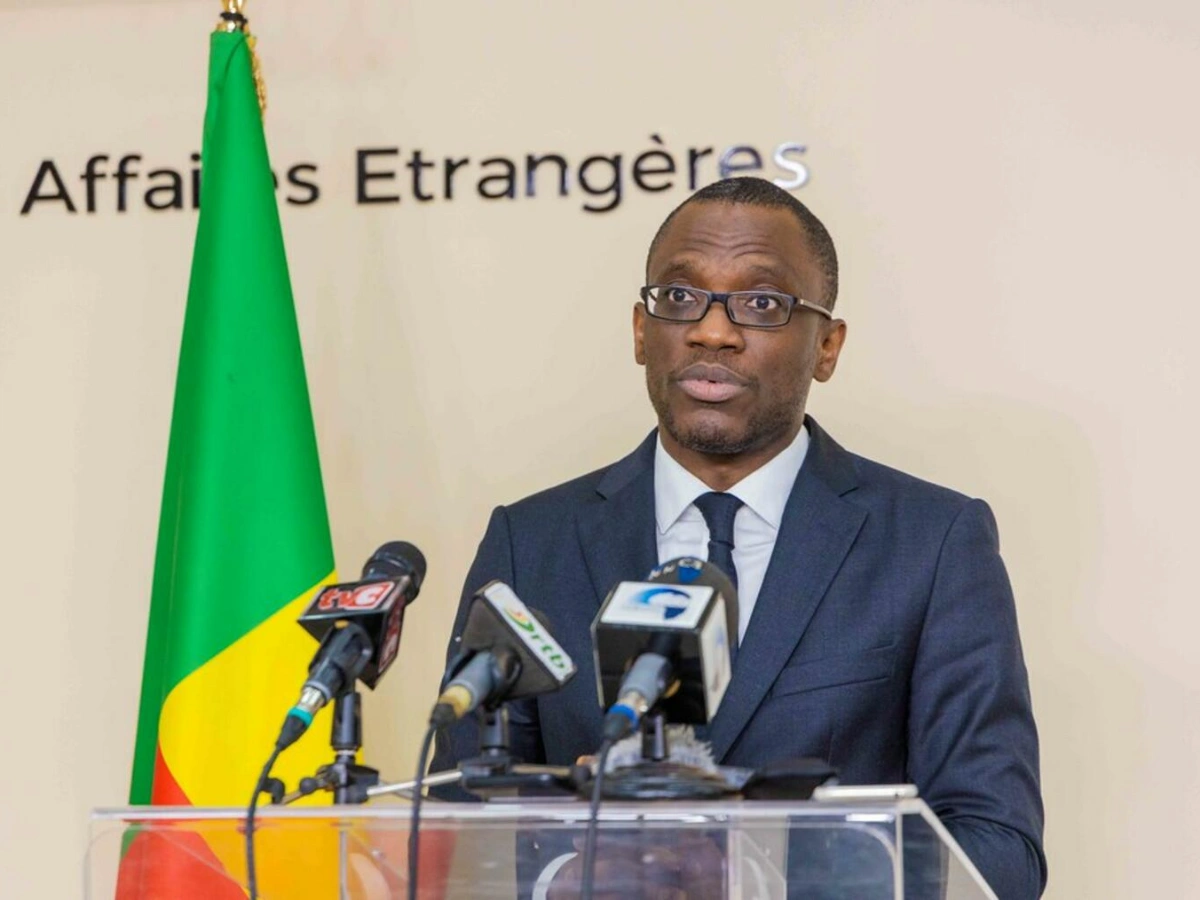
"People of Afro-descent are not simply distant members of our family, they are our children, our brothers, our sisters. By recognizing their right to return, we tell them: you have never ceased to belong to this land."
"The people of Ouidah, Beninese, and Africans must take responsibility by opening up to Afro-descendants."
"This ceremony is a powerful act of recognition, reparation, and reconciliation. Benin faces its past with clarity and transforms a historical wound into a perspective that carries the future forward."
A conversation with Césaire
One day, Georges-Emmanuel Germany discovered that Aimé Césaire was his grandmother's first cousin. When the two met, Germany asked which direction to take in life. Césaire's reply set everything that followed in motion:
"The direction is Africa."
"And Créolité?"
"That's just something they invented to turn us from Africanité."
Germany pushed back – there are 54 countries on the continent, where does he start? Césaire told him to start with Haiti, since that was where Césaire himself had found the deepest roots of his own Martinican identity.
But it was in Benin that the thread connected. In Allada, Germany learned the town was said to be the ancestral home of Toussaint Louverture's family – the same Toussaint Louverture who led Haiti's liberation!
A local dignitary told Germany he carried royal blood. A fâ divination confirmed it. Face to face with the King of Allada, he heard the words that made it real:
"Choose your coat of arms – we're going to crown you."
On August 20th, 2016, the King of Allada crowned him prince, with the title Dah Milèko.
Offered informal documents on the side, Germany refused. He wanted something bigger than a personal fix – a law recognizing a right of return for everyone, not just himself – and not conditioned on years of residency first, the way Ghana's version worked after Afro-diasporans advocated for a similar program there. Germany wanted recognition to be immediate.
For years, he could get ministers to listen but never five minutes with President Talon. Until finally one day an opportunity in disguise presented itself: a béké (colonizer) named Bernard Hayot, who Germany describes as "the owner of the island and everyone who lives there," invited Talon to Martinique to inaugurate a Beninese art exhibition. The invitation caused real outrage – Martinique's territorial council president publicly refused to attend, saying it "deeply offends my political and moral conscience," and the local prefecture banned public gatherings ahead of the opening after online calls to protest.
Germany was part of a delegation of protesters who met with a minister from Benin to advise how best to handle the situation. Thanks to this delegation, the trip was a success, and Germany took advantage of a moment with the president of Benin to make an impression:
"I lost my papers 300 years ago in a ship's hold – it's about time you reissued them."
President Talon invited Germany to meet with him a few weeks later and asked him why he wanted to become Beninese.
"I don't want to become Beninese. I already am – it just so happens you have the papers and not me."
"What proves you're Beninese, and not Togolese, Senegalese, Cameroonian, Ivorian, or Congolese?"
"That's a question you have no right to ask, because it's exactly the question the crime was designed to make unanswerable. The crime against humanity was this: taking us from here and there, mixing us together so we couldn't communicate, couldn't organize, couldn't rebel – and above all, stripping us of our names, our languages, the right to speak them, our relationship to God and the right to practice it, and finally, the name of our village, our kingdom. So reparation means giving us back the choice – the right to choose whichever country we want."
Then came the practical question, and when asked what was in it for Benin, Germany pointed to the diaspora's reach and influence worldwide. They negotiated the shape of the law on the spot: proof of Afro-descent, not proof of Beninese origin specifically; full citizenship after a period of years, but immediate Right of Abode from the moment the provisional Certificate of Eligibility is received. Once the bill reached parliament, Germany worked to line up support to ensure it passed unanimously, which it did.
"This law is an act of reparation, a way of giving Afro-descendants back a piece of their history and their identity."
Opening the doors
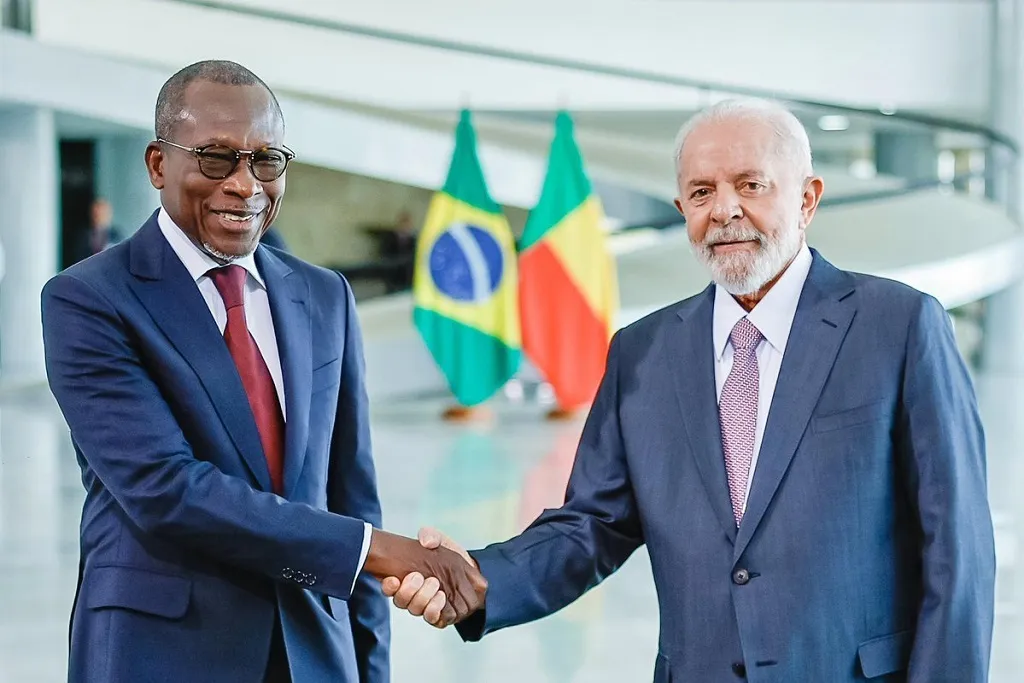
Two weeks after the government's decision, Talon was in Brasília for a state visit – since Brazil is home to more Afro-descendants than any other country outside Africa, Talon announced the new law at a joint press conference with President Lula:
"All Afro-descendant Brazilians are Beninese. That's a treasure for Benin, for Africa."
Then he turned to face Lula:
"From now on, Mr. President, you will be Beninese!"
Where they were taken
The Trans-Atlantic Slave Trade was the largest forced migration in human history, but only one branch of a wider system that moved captives across the Sahara, the Red Sea, and the Indian Ocean for over a thousand years combined. The chart below traces the volume and routes of that trade: the scale Benin's law was written to answer.
Ancestors trafficked
| Country / territory | Trafficked | Afro-descendants today |
|---|---|---|
| 5,532,129 | 112.7M (55% of population) | |
Jamaica | 1,212,346 | ~2.7M (90%+ of population) |
Haiti(Saint-Domingue) | 911,142 | ~11.7M (95%+ of population) |
Cuba | 889,989 | ~4.5M (35% of population) |
Barbados | 608,956 | ~240K (90%+ of population) |
| 472,372 | ~43M (13% of population) | |
Colombia, Venezuela & Spanish Caribbean | 372,065 | ~5M+ across both countries |
Suriname & Dutch Guiana | 340,989 | ~600K (37% Afro-Surinamese) |
Peru, Mexico, Honduras & other Spanish Americas | 297,876 | ~5M+ across region |
Martinique | 261,048 | ~330K (90%+ of population) |
Dutch Caribbean (Curaçao, Aruba, Bonaire) | 173,204 | ~200K |
US Virgin Islands & St Croix(Danish West Indies) | 129,864 | ~50K |
Guadeloupe | 87,845 | ~390K (90%+ of population) |
| Total (all destinations) | ~10,700,000 | ~200M today |
| Didn't survive the Middle Passage | ~1,800,000 | – |
Who is eligible?
Benin's Law N° 2024-31 (amended N° 2025-11) covers any person who can prove descent from a sub-Saharan African trafficked out of mainland Africa by any slave trade – including the Atlantic, Indian Ocean, Red Sea, and trans-Saharan trades. There is no fixed list of eligible countries. African island nations (Cape Verde, São Tomé, Mauritius, Seychelles, Comoros, Réunion): if you have an Afro-descendant ancestor born before 1944 on one of these islands, you could qualify – but the law stipulates you cannot already hold citizenship of any African country, which includes these islands.
Source: SlaveVoyages Trans-Atlantic Slave Trade Database, Estimates (slavevoyages.org) – figures are people embarked from Africa. Afro-descendant population: Brazilian IBGE 2022 census, UN ECLAC, national censuses. Self-identification rates vary significantly by country.
Patrice Talon & the decade of change
Patrice Talon led Benin as president from April 2016 to May 2026. Before taking office, he built his career in the cotton industry through the 1980s and 1990s and spent years as an influential political financier, before winning the presidency with 65% of the vote in the second round.
He came to power promising a different kind of governance: leaner, more technocratic, less corrupt. His first act was to try to limit himself to a single five-year term – an unusual move in a region where leaders tend to extend their mandates, not shorten them. The constitutional reform failed to pass parliament, but it set the tone for a presidency that consistently defied easy categorization.
What changed
The economic record is substantial. GDP growth rose from 3.3% in 2016 to 7.5% in 2024 – the highest rate since 1990 – and was projected at 7% for 2026. The Human Development Index rose from 0.351 in 1990 to 0.515 in 2023. The government's two flagship reform programmes (PAG 2016–2021 and PAG 2021–2026) together committed more than 9,000 billion CFA francs – roughly $16 billion – to infrastructure, energy, agriculture, and digital services. Corruption perceptions improved: Benin moved from 95th out of 176 countries in 2016 to 70th out of 180 in 2023 on Transparency International's index. Social spending rose from 32.6% to 43.8% of the budget between 2018 and 2022.
Talon was deliberate about utilities reaching the whole country, not just cities. Electricity access expanded – urban coverage reached 69%, rural coverage 36% by 2026, with a target of full national coverage by 2030. The approach came with a trade-off he explained directly to citizens, in an exchange with the youth in July 2025: utilities were kept a bit more expensive, so the revenue could fund expansion to new areas. "We can't say we're happy to be independent and still keep holding out our hand to those we chased out," he said – a philosophy that drew both admiration and criticism. Road infrastructure expanded significantly. Free schooling for girls was extended to the end of lower secondary education, rolled out nationally from October 2024. A plan for 60 vocational schools – for agriculture, mechanics, plumbing, electricity, and internet – was financed and ready to build by the end of his term, with construction to begin within months of his departure.
The Glo-Djigbé Industrial Zone (GDIZ), launched in 2021 on 1,640 hectares near Cotonou, processes cotton, cashew, soy, shea, and pineapple locally rather than exporting raw materials. Tourism became a deliberate pillar. The Amazon Statue – a 30-metre monument to the Dahomey women warriors – was inaugurated in Cotonou in 2022. Sacred artworks looted by French colonial forces were formally returned in November 2021, and went on public exhibition in Cotonou that February. Annual Vodun Days festivals positioned Ouidah and Benin as a global cultural destination. During his visit to Martinique, President Talon even invited the Beninese diaspora to a discussion where they could share their thoughts about the ongoing changes. And in 2024, the law on Citizenship by Recognition for Afro-descendants was passed unanimously!
Many Beninese clearly admire him. He had an unusual style for a head of state – sitting at the same level as citizens in public forums, asking questions before educating, inviting young people to meet regularly at the Hall of the People for mentorship and dialogue. "It's never too late to do right," he said at one such meeting. A 2024 Afrobarometer survey found 60% of Beninese citizens considered their country democratic, and 77% said they preferred democracy over any other political system.
The Flip Side
The democratic picture is more contested. "We chose a political order similar to the colonizer's – democracy – to satisfy our quest, our need for freedom, for development," he said in that same exchange. Benin had been one of West Africa's most celebrated democracies – the country that in 1991 achieved the first peaceful transfer of power from a dictator to an elected president in sub-Saharan Africa. That reputation frayed significantly under Talon.
Electoral reforms in 2019 required parties to clear a 10% national vote threshold to win seats in parliament, effectively sidelining the opposition: that year's elections saw voter turnout collapse to 25%. In 2021, some opposition candidates were barred from running through what critics called politically motivated criminal charges. Freedom House downgraded Benin from "Free" to "Partly Free." In January 2026, legislative elections saw the opposition fail to reach the 10% threshold again – all 109 parliamentary seats went to government-supporting parties. The Constitutional Court – nominally independent – came to be headed by Talon's former personal lawyer.
In December 2025, Talon extended presidential terms from five to seven years through a constitutional reform and created a Senate – on which he is expected to remain as a member after leaving the presidency. A coup attempt the same month was suppressed. His presidency ended on May 24, 2026, when he handed power to Romuald Wadagni – his own former finance minister and the architect of much of the economic programme – who won with 94% of the vote.
Talon leaned toward deregulating, instead of expanding worker protections, saying a freer labor market creates more jobs than a heavily regulated one – with the United States cited as a model pairing low regulation with low unemployment: "I'd rather deregulate employment to create jobs than regulate it and create none at all," as he put it in a July 2025 exchange with the youth. The approach drew support from those who point to strong job growth during his tenure and criticism from those concerned it left workers with fewer protections.
What this means for applicants
The Citizenship by Recognition for Afro-descendants law was passed under Talon and remains fully in force under President Wadagni. The program is embedded in Beninese constitutional law and is not dependent on any individual president.
Ready to start your own application?
Citizenship JourneySources Cited
President
- [EN]Africanews – "After a decade in power, Patrice Talon leaves a divided legacy in Benin" (May 21, 2026)
- [EN]Ecofin Agency – "Benin: A Decade of Infrastructure-Driven Transformation" (Apr 28, 2026)
- [EN]Ecofin Agency – "Benin's Decade of Reform-Driven Economic Transformation" (Apr 20, 2026)
- [EN]Ecofin Agency – "Building Connectivity in Benin: Progress and Gaps in the Road Network"
- [EN]Ecofin Agency – "Benin's Agricultural Shift, by the Numbers" (Apr 23, 2026)
- [EN]Ecofin Agency – "Benin: Govt approves $20bln Action Plan for next five years" (Dec 2021)
- [EN]Ecofin Agency – "Inside Benin's New Government Under Wadagni" (May 27, 2026)
- [EN]World Bank – "Electricity's Impact in Benin: Transforming Lives Pole by Pole" (Mar 2026)
- [EN]World Bank – Benin country page
- [EN]BMZ – "Systematic course of reform, but restrictions on political freedoms"
- [EN]BTI 2026 – Benin Country Report
- [EN]Africa Minigrids Program – Benin rural electrification dialogue (Mar 2026)
- [EN]Ecofin Agency – Free secondary education for girls (June 2026)
- [FR]Maliactu – "Bénin: Bilan des dix ans de réformes de Patrice Talon (2016–2026) et perspectives"
- [FR]Zapping Médias – "2016–2026: comment Patrice Talon a redessiné l'économie béninoise"
- [FR]Jupiter Info – "06 avril 2016 – 06 avril 2026: 10 ans de pouvoir, 10 ans de rupture" (confirms ~9,000 milliards FCFA PAG investment, 6–7.5% growth)
- [FR]ASPA (Afro Sync Press Agency) – "L'héritage de la Rupture: le bilan contrasté des dix ans de l'ère Patrice Talon" (confirms Wadagni's ~94% result)
Lula
- [FR]Jeune Afrique – "Avec Lula, le Brésil retrouve ses ambitions africaines" (May 25, 2024)
- [FR]Mondafrique – "Notre portrait de Patrice Talon, président du Bénin et homme d'affaires prospère" (June 16, 2024)
- [FR]La Nation (Bénin) – "Visite de travail au Brésil: Tête-à-tête entre Patrice Talon et Lula da Silva"
- [FR]La Nation (Bénin) – "Séjour au Brésil: L'émouvante visite de Talon à Salvador de Bahia"
- [FR]AllAfrica – "Bénin: Patrice Talon au Brésil - Quelles retombées pour le pays ?" – confirms the May 23–26, 2024 itinerary in detail
- [EN]NPR (photo caption via AP) – Talon/Lula meeting, Planalto presidential palace, Brasília, May 23, 2024
- [PT]Geledés – "Cidadania para a população afro-brasileira" (quotes Talon's Itamaraty remarks in Portuguese)
- [PT]Aventuras na História – "Benim: Entenda o projeto para dar nacionalidade a todos os afrodescendentes do mundo" (quotes the same line, with photo of Talon beside Lula)
- Video of the original press conference (Brasília, May 23, 2024)
Quotes
- [EN]Globalcit.eu – legal analysis citing Bakari's 28 Sept 2024 UN General Assembly speech verbatim
- [ES]OHCHR (Spanish) – "Regresar a África: las personas de ascendencia africana buscan un estatus único", reproduces Bakari's quote in Spanish translation
- [FR]Gouvernement du Bénin – "Retour aux sources et reconnaissance: 22 Afro-descendants obtiennent la citoyenneté nationale" (Sossa, 22 May 2026 ceremony)
- [FR]Bénin Web TV – "Bénin: remise d'attestations de nationalité à 22 Afro-descendants" (corroborates Sossa's remarks, same ceremony)
- [FR]Le Matin (Bénin) – "Entre reconnaissance historique, vingt-deux déportés rentrent à la maison"
- [FR]Gouvernement du Bénin – "Initiative My Afro Origins: le Bénin remet de nouvelles attestations de nationalité à des Afro-descendants" (Hungbo, closest verbatim match)
- [FR]L'Événement Précis – same ceremony (3 Jan 2026)
- [FR]Presidency of Benin – official Flickr album, 3 Jan 2026 ceremony
- [FR]Notre Époque – same ceremony (3 Jan 2026)
- [FR]La Nouvelle Tribune – "Nationalité béninoise: 21 Afro-descendants officiellement reconnus par l'État"
- [FR]SRTB – "Bénin: 21 Afrodescendants accèdent à la nationalité béninoise"
Further reading
- [FR]gouv.bj – Vodun Days festival recap
- [FR]Jeune Afrique – "Afrodescendants au Bénin: cinq questions pour comprendre la stratégie de Patrice Talon" (broad explainer)
- [FR]KOACI – "Bénin: Patrice Talon promulgue une loi accordant la nationalité aux Afro-descendants" (law promulgation, Sept 2024)
- [PT]MigraMundo (Portuguese) – "Na contramão do Norte Global, Benin concede cidadania a afrodescendentes" (broad explainer, also quotes the Itamaraty line)
- [PT]O Liberal (Portuguese) – "Brasileiros estão buscando cidadania em país africano ligado à história da escravidão" (broader movement context, incl. chef João Diamante)
Germany
- [FR]TRT Français – "Je suis Africain et Martiniquais, une loi béninoise séduit les Antillais" (interview) – confirms the Allada/Toussaint Louverture connection and the "j'ai perdu mes papiers... à fond de cale" line to Talon almost verbatim as retold on-page
- [FR]BIP Radio – "Georges Emmanuel Germany : Le retour à la nationalité béninoise est un acte de réparation historique" (interview) – confirms Germany's Allada princehood (Dah MILEKO, since 2016), Ambassador role, and general reparation framing